
Poetry translation is one of the industry’s greatest linguistic challenges. For a translator, it represents a real opportunity to put our writing chops to the test and create, arguably, another piece of poetry altogether, bonded to the source text while standing alone in its own right.

Over the last few years, I’ve had the chance to work on a few projects that have involved the translation of poetry, all the way from full narrative poems to subtitling French drill. Here’s a look back at some of these projects, and the challenges and processes involved in their translation.
Une châtelaine envahissante
In the summer of 2021, I was asked by a Scottish translation agency to complete a test translation for a French poet who had been doing the rounds of different agencies, looking for the right translator to take on his 38-page narrative poem. After being selected by the author, I worked on the text for around a month, in close dialogue with the poet. The client brief was challenging to say the least – he wished to conserve both meaning and rhyme as much as possible. His main inspirations were Baudelaire and Lord Byron, and he wanted the translator to take inspiration from the French translation of Shakespeare’s sonnets – no pressure!
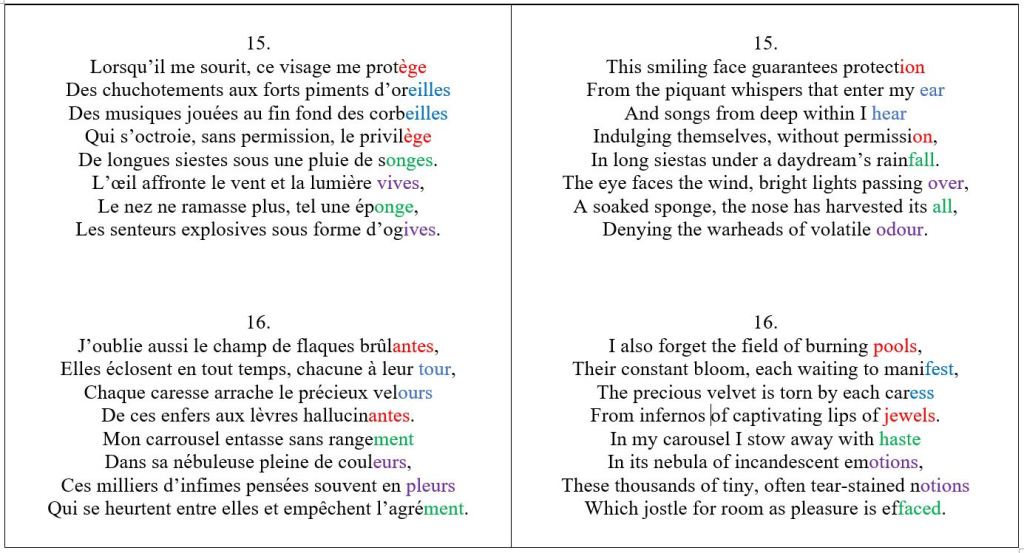
This excerpt demonstrates the rhyme pattern found in these poems. Replicating rhyme in translation often inherently involves a slight change in meaning, or at least a change in structure, which can be seen above. As the rhymes were mostly found at the end of each line, this acted as a constraint that would often need to be counterbalanced by the rest of the line. In an attempt to preserve meaning as much as possible, I used the rhyming word as a starting point, and worked the rest of the line to create a mirror image that would not stray too far from the source, while still conjuring up an effective image in English.
This poem takes the reader on a journey through a series of highly sensory metaphors, creating a sort of feverish dreamscape in which we plunge into the poet’s innermost emotional states. While trying to keep track of the general plot that guides the impressionistic verses, I treated each verse as a visual, sensory moment in itself, as a kind of word painting. Sometimes, near rhymes were the only available option in the semantic field associated with each line, but these nonetheless offered a certain musical symmetry, such as “manifest” and “caress”.
Creative licence was admittedly taken quite frequently, all under the watchful eye of the client, with whom I would discuss these decisions whenever necessary. The translation of “lèvres hallucinantes” as “lips of jewels” was an example of this. I needed to confer with the poet to find the exact image he wanted to convey, as “hallucinatory” was simply not an option (far too clunky and sterile). In the end, the important meaning to retain was this sense of marvel, in keeping with the near-delirium and enchantment provoked by feminine beauty in the poem.
The client was ultimately very pleased with the result and was touched to see his work translated into English. Looking back on this project, it would have been beneficial to talk one on one with the client via Zoom, rather than by e-mail. This, however, is the disadvantage of working with an individual client on a personal project through an agency. I hope to secure more private clients in the future for projects of this type.
Lisez-vous le belge ?
This project, as mentioned in my previous post, was one of my highlights of 2022. A campaign ran by Wallonie-Bruxelles International, its aim is to promote French-language literature from Belgium around the world. The project was a brochure comprised of a series of extracts of works by a selection of authors from the world of poetry, bande dessinée, fiction, non-fiction, YA and children’s literature. Here is one example from the brochure:
Virgin by Joëlle Sambi
The brochure opens with a high-impact slam poem by Belgian-Congolese poet and author Joëlle Sambi. Her work takes inspiration from the likes of Toni Morrison and Audre Lorde, and deals with themes of queerness, race, institutional violence and their intersectionalities. Below is my translation of one of her poems taken from her poetry collection Caillasses (Gravel), which received a literary award from the SCAM.
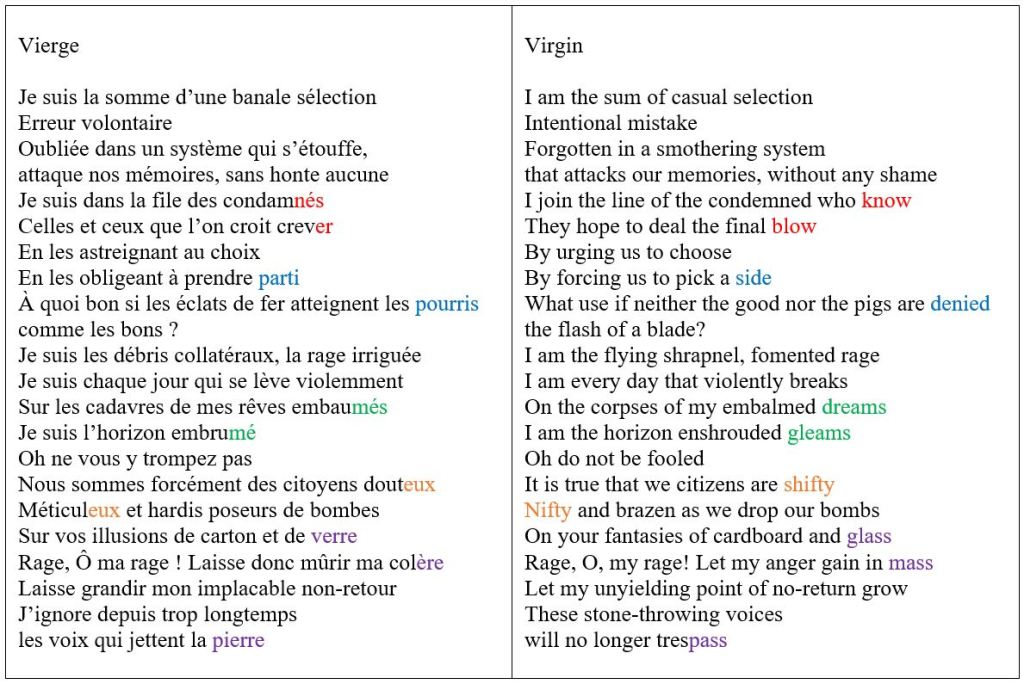
This poem was an interesting one to translate as it is extremely hard to transmit the pure emotion and raw power of slam poetry whilst approaching the text as an outsider. I would love to see alternative translations of the poem to compare and contrast, as the text could be handled in a number of ways. The three levels of separation during this project between me and the author made it hard to treat the project in the same way as I would treat a published translation, limiting the potential for dialogue that you find in long-term projects, but I nevertheless wanted to maintain a strong message and similar meter.
One of the greatest challenges here was how to translate the line: “À quoi bon si les éclats de fer atteignent les pourris / comme les bons?” After discussing the poem with a French speaking friend, we came to the conclusion that “éclats de fer” insinuated the presence of a weapon, and that “pourris” was likely to be a reference to the police. It was essential to preserve the meaning in this line, whilst not jumping the gun and ending up with a target text that assumes more than it translates. My solution to this was to shift the sentence structure so that I could get a nice rhyme between “side” and “denied” and find a nice natural split for the enjambement, while leaving the reader with a strong visual impact (“the flash of a blade”).
Here, I prioritised flow, message and rhyme placement. This meant that unfortunately some imagery had to be altered to the same effect. For example, I would have liked to include the image of “laisse donc murir ma colère” (“let my anger ripen”) but finding a good rhyme for the rather unforgiving words “cardboard and “glass” with a synonym for “ripe” or “ripen” proved to be very difficult. My solution was to keep an image of something growing, just like a ripening tomato swells and changes colour, hence the phrase “let my anger gain in mass”.
Personally, I loved this poem as well as the other slam poem included in the brochure, and look forward to reading more of Sambi’s work or maybe seeing her perform live if she stops by Lyon one day.
What poetry translation means to me
I have always found poetry translation from French into English to be extremely rewarding. I consider myself to be more of a “musical” than a “textbook” language learner, initially relying on the musicality and sound of a language to get to grips with it rather than pouring over grammar tables. These types of poetry translation services, along with editorial or even marketing translation, have a certain quality that engages the same part of my brain that helped me the most during my learning of French, Spanish, and now Greek! Starting the day by marking out rhyme patterns and meter and getting the old-school paper dictionary out; sitting in a pub and analysing my translations with a native speaker or fellow translator; a poet telling me that they found my translation moving and that it captured the poem’s essence… Those are the moments when I feel really lucky to be doing this as a career.


 Rayo Translations