Discovering Greece’s unexpected Francophilia

« Γάλλοι καὶ Γραικοὶ δεμένοι
μὲ φιλίαν ἑνωμένοι,
δέν εἰναι Γραικοὶ ἢ Γάλλοι,
ἀλλ’ ἕν ἐθνος, Γραικογάλλοι »

“The French and Greeks are allies,
united by friendship,
they are not simply the Greeks or the French,
but one single people, the Francogreeks.”

Adamantios Korais, 1800

Of all my expectations coming to Greece as a translator, discovering a shared affinity for the French language was not one of them. Now having recently moved to Athens, I’m starting a new chapter in my language learning journey, and finding connections with my other working languages is helping me to find a sense of community here.

As I explore these busy, chaotic streets from Spanish language bookshops to the Institut Français de Grèce, and as I gradually get to grips with B1-level Greek, I can’t help but notice the tangible presence of French both in the language and the Athenian cityscape itself. After my initial reaction of “Huh, that’s cool!” I did a little digging and uncovered a rich history and lexical tradition unique to this country.

So, with no further ado, here is my little καρτ ποστάλ (carte postale) from Athens to give you a little taste of the κουλέρ λοκάλ (couleur locale)!
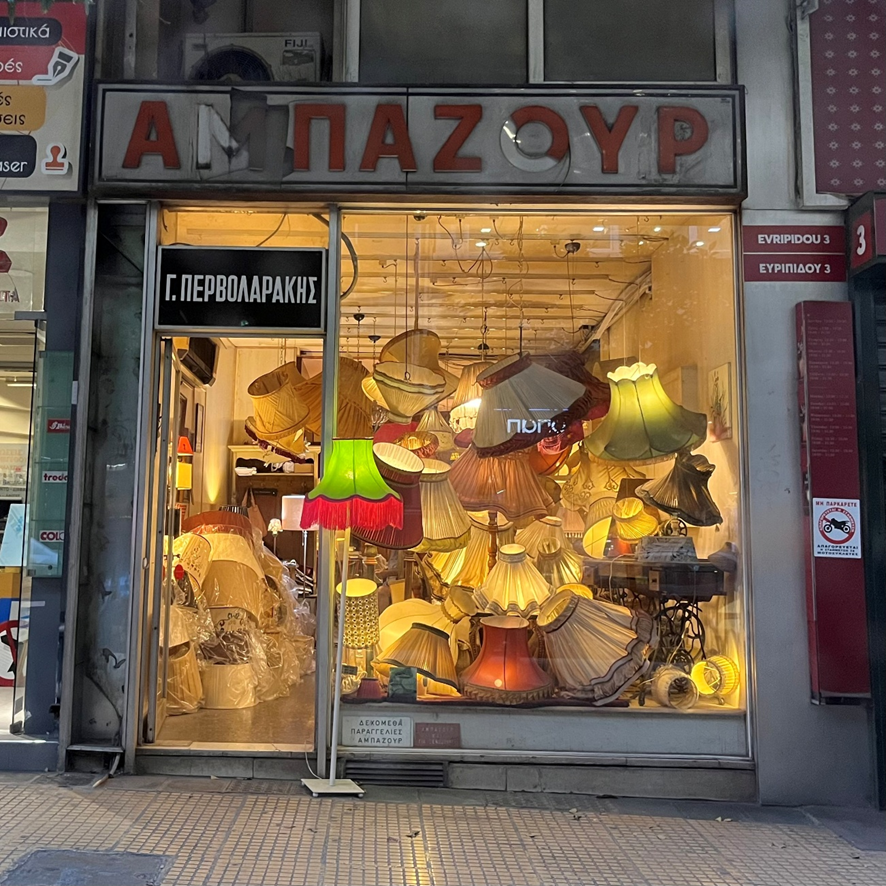
Aμπαζούρ – abat-jour – lampshade (Monastiraki, Athens)

Centuries of mutual admiration

According to one study by Sina Ahmadi based on the work of linguist Ilias Konstantinou, French currently represents 18.3% of all loanwords in the Modern Greek language, just after Turkish (21%) and Italian (22.2%). It has also been shown to be its greatest source of semantic loans. There is a long history of contact between the French and Greek languages, two traditions equally steeped in pride and rich history, but it was not until the Enlightenment that this influence truly became apparent. Viewed as the language of Descartes, the language of reason, French’s illustrious reputation remained, and from the 18th to the 20th century, young Greek scholars such as Korais or Psicharis would choose to complete their studies in France, bringing ideas, literature and terminology back home with them.

Furthermore, the Grecomania taking the northern European elite by storm reflected Greece’s own history back at it via the rose-tinted mirror of neoclassicism, further feeding this sense of mutual admiration.

“Greeks were exposed to the Enlightenment mentality by multiple books in translation, newspapers and periodicals. By entering into closer contact with Western Europe, the Greeks also rediscovered the heritage of their own ancestors. The return to Antiquity and the neoclassicism that defined the Age of Enlightenment had repercussions within Greece. A Greek conscience emerged along with a strong interest in the past.”

(quote taken and translated from Tiebout, Miet, L’influence du français sur le grec moderne : le domaine du calque)

In the early 20th century, the forced expulsion of Minor Asian Greeks to Athens and other cities around Greece brought with it a new composite, parallel culture and a new oral tradition. Large numbers of those torn from their homes in Minor Asia were highly educated and multilingual; many were fluent in French, having left behind positions in the diplomatic, administrative, academic and trade sectors. Cities like Smyrna and Constantinople were major trade hubs and cultural melting pots, vestiges of the “multi-confessional, extraordinary polyglot Ottoman world.” As these individuals were forced into urban ghettos in mainland Greece, stripped of their wealth and belongings, this once lofty language saw a certain “fall from grace.”

Culturally rich underworlds began to emerge from these highly marginalised urban centres in Greece. The vernacular of this community seeped its way into rebetiko, a musical genre with deep roots in Minor Asia, which soon gained popularity among the general Greek population. This was a linguistic tradition that greatly featured loanwords not only of Turkish, but also of French origin, and this can still be heard today in the lyrics of early rebetiko.

Not your average Francophile: introducing the ‘mangas’

In the UK, French loanwords are more immediately associated with pretention, the upper class, your Frasier Cranes of the world… Not so much with crime and seedy dealings in smoky basements. In the latter half of the 20th century, however, French, along with Turkish, played a central role in shaping the lexicon of the iconic Athenian gangster and man about town: the “mangas” (μάγκας). In popular depictions, the sharply dressed, komboloi-flipping mangas can often be heard dropping in French loanwords such as σιλάνς (silence, defined by slang.gr as “a more mangas-like yet polite way to say ’shut up’”); αρζαν (argent; money), or ανφάν γκατέ (enfant gâté; spoilt kid).
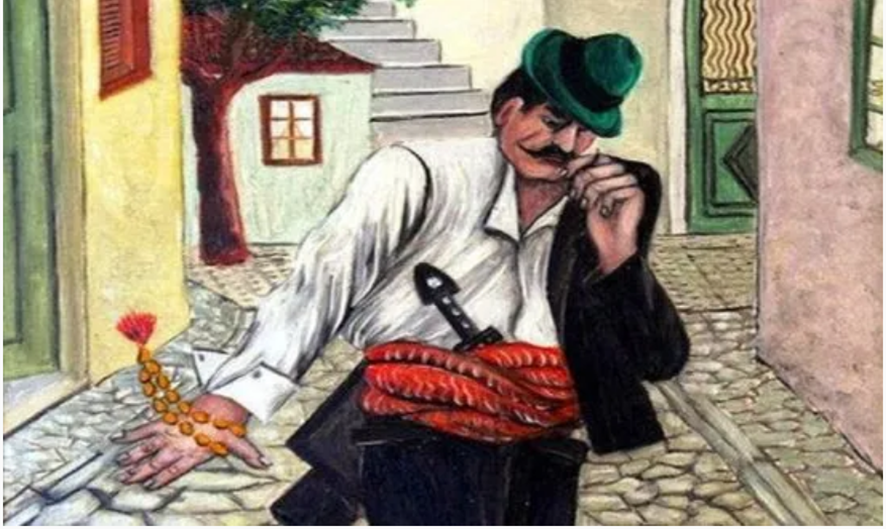
A “mangas” with his characteristic moustache, komboloi worry beads, suit, hat
and knife tucked into the belt.

French loanwords continue to carry this connotation of street smarts and gritty cosmopolitan charm to this day, although the generations that had adopted this style of speaking are slowly dying out, with French loan words competing neck-and-neck with Anglicisms among younger speakers and the chronically online. French words are still commonplace in everyday Greek, often used for 19th or 20th century inventions, words relating to cars and car parts, philosophical concepts, and fashion and beauty terms. For example, when someone is getting ready for a party, they are doing their beauté (μποτέ)!

La belle fleur – The Beautiful Flower (Pangrati, Athens)

Case study of French loan words thriving in Modern Greek: a song by Nalyssa Green

Over the last few months, as I mulled over these connections between these two languages that mean so much to me, I came across a sugary-sweet love song by Athens artist Nalyssa Green. The song is entitled Κρεμ Καραμελέ, “Crème Caramel”—a fittingly nostalgic dessert. Here, we see French loanwords beautifully interlaced with Greek. Let’s take a closer look with my attempt at an English translation (French loanwords shown in red):
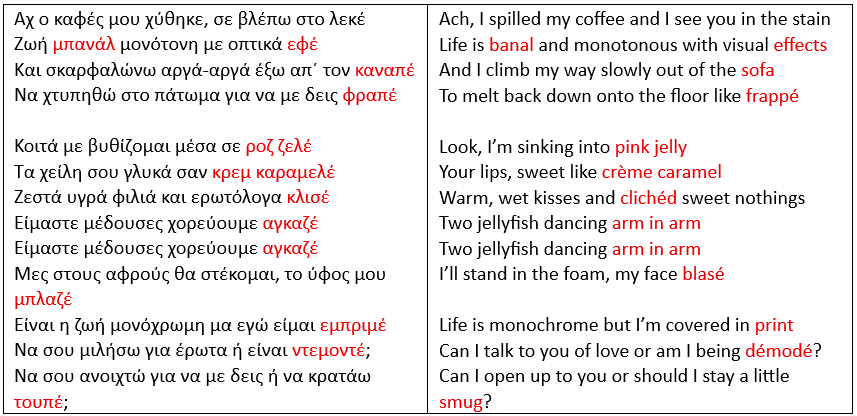
Here, in such a short song, we have no less than 12 French loan words, used not only as a rhyming scheme but also as a way of creating rich, nostalgia-coded imagery: μπανάλ (banal), εφέ (effets; effects),  καναπέ (canapé; sofa), φραπέ (frappé), ροζ (rose; pink), ζελέ (gelée, jelly), κρεμ καραμελέ (crème caramel), κλισέ (cliché), αγκαζέ (engagé, arm in arm), μπλαζέ (blasé), εμπριμέ (imprimé, printed), ντεμοντέ (démodé), and, rather unexpectedly, τουπέ (toupé) meaning arrogant or bold. One might be tricked into thinking leké (λεκέ, stain) was a French loan word too, but—surprise! It’s Turkish.

These lyrics demonstrate, in its most indulgent form, the Greek affinity for the French language and its power as a stylistic device. Here, and more generally in Greek, we find a predilection for the “é” sound, which us Anglophones can agree does sound pretty classy. Some of these loans conjure up an image of early 20th century Europe, such as the term engagé – in this context, “dancing together” – which I imagine must have stemmed from early dance halls, when someone was “otherwise engaged” on the dancefloor.  I can’t help wondering, where does French lie today in the modern Greek psyche—in the smoky, street-smart roots of mangas culture and early rebetiko, or in the dreamy realm of bygone cosmopolitan charm and romance?
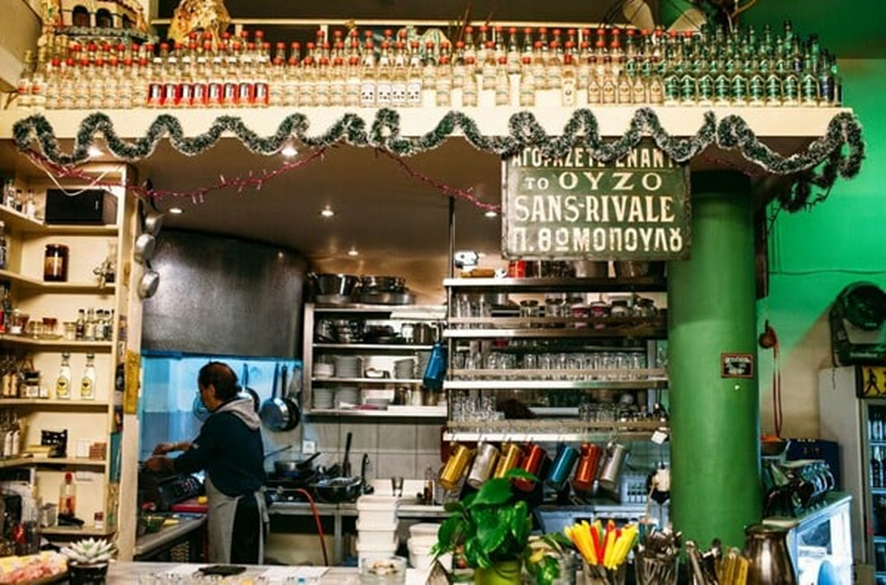
A sign advertising ouzo “sans rivale” in the bar Pαντεβού (rendezvous) (Petralona, Athens).
Source: LiFO https://www.lifo.gr/various/ayta-einai-ta-kalytera-ton-petralonon

Points of confluence and navigating the Anglo-Franco-Greek space as a translator

This only scratches the surface of the complex world of Modern Greek, so beautifully shaped by all its foreign influences and tumultuous history. From the shop fronts of Athens to the gooey-eyed lyrics of Nalyssa Green, we see exactly how trade, music and migration can smash down the boundaries between foreign languages, defying borders and so-called linguistic purism.

The space I occupy as a translator in this country is equally fluid. While my level of Greek is not yet sufficient for taking on translation projects, I am trying to find my place as a French translator within this new Greek context, and that means sniffing out the niches where my skills might be of use.  Wine and gastronomy seem to be an interesting path to explore, as they are so closely interlinked with the largely English-speaking tourism industry and French tradition. Fashion is another interesting point of convergence, and as more and more sustainable clothing brands are coming out of France, I see an excellent opportunity for synergies with small Greek fashion brands, a market that is visibly thriving in the capital. Whether there is any demand here for English translation or copywriting is yet to be seen, but I nonetheless find these crossovers fascinating as a language enthusiast and citoyenne du monde. For now, it’s still early days in this new Greek chapter of mine, so all I can say is watch this space! Σας μερσώ! Ωρέ ντουβάρ!*

*a little inside joke for any Greek readers who’ve made it this far

Find out more

Curious about which Modern Greek words come from French? Here is a very thorough list of all the most common French loanwords (in Greek and French). I was particularly surprised to find ζαμανφουτισμός (je m’en foutisme) on the list!

Want more information on the Minor Asian Catastrophe and its effects on Greek culture? This blog post by Europeana Subtitled provides a great overview with archive documentary footage subtitled in English.

Liked the look of the vintage shop front photos used in this article and interested in learning more about the shops that define Old Athens? Check out this article featuring some of the familiar faces I see every day around my office in Omonia.

In need of any translation or interpreting services that require extensive knowledge of the French and Greek cultures? Looking for some English language copy to promote your business in France or Greece? I’ve got you covered! Get in touch for more info on my rates and services.

References:

Agravaras, D., “Marking 100 years since the end of the Greco-Turkish war”, published 14/09/2022 on https://www.europeana.eu/en/stories/the-asia-minor-catastrophe (accessed June 2025)

Ahmadi, S., “Foreign loanwords in Modern Greek”, published 18/03/2019 on sinaahmadi.github.io (accessed June 2025)

Coray, A. (Κοραή Α.) Άσμα Πολεμιστήριον των εν Αιγύπτωι περί ελευθερίας μαχομένων Γραικών, Αίγυπτος: Παρίσι (1800)

Fliatouras, A., “Πόσα και ποια δάνεια έχει η σύγχρονη κοινή νέα ελληνική; Μια πρώτη προσέγγιση.” Γλωσσολογία/Glossologia 29 (2021)

Mazower, M. in Shields, S., “The Greek-Turkish Population Exchange” in Middle East Report No. 267 (Summer 2013)

Tiebout, M., “L’influence du français sur le grec moderne : le domaine du calque” (Ghent University, 2009)

The hidden poetry of museum translations

From a young age, I’ve always preferred working behind the scenes to centre stage. I left school with a strong ambition to work in costume and set design for film and theatre, but after finding my path in languages and history of art, I realised that there were so many ways to recreate that backstage excitement. Museum translation definitely scratches that itch, and it has come to be one of my favourite disciplines as a creative professional translator. In this article, I take a look at some of the secrets and pitfalls that can make or break a multi-lingual exhibition, with a particular focus on French to English translations.

Keeping the voice evocative but accessible

Nobody can deny the beauty of the French language. Those who truly master it can push it to its elegant, playful and more abstract limits. This linguistic prowess can make for some beautiful texts, particularly in a museum context, but sometimes as translators we find the need to latch on to something more tangible in order to find the right flow in our translation. English does tend to be punchier and more direct, but this does not mean that any elegance or poetry needs to be lost in the final text.

The main challenge when translating exhibition labels, wall text or brochures from French into English is to grasp the meaning, maintain the style, and transform it into something equally evocative for an English reader. But there is one caveat – exhibition texts are displayed side by side, leaving any translation “exposed”. Delve too voraciously into transcreation, and you may fall prey to the critical eye of any bilingual visitors. Stay too close to the text, however, and you risk producing a rather waffly translation that readers can’t identify with. Museum visitors seek emotional engagement and will rarely have the patience to unravel tangled prose in order to seek meaning. A convoluted text can also be quite alienating for the visitor, leaving them feeling not “smart enough” and with a sense of imposter syndrome.

My solution? Making sure I fully understand what the source is trying to convey and formulating my translation after carefully examining the artwork in question. By forming my own emotional response as a viewer-translator, I can provide a natural sounding translation that is more likely to engage the museum visitor.

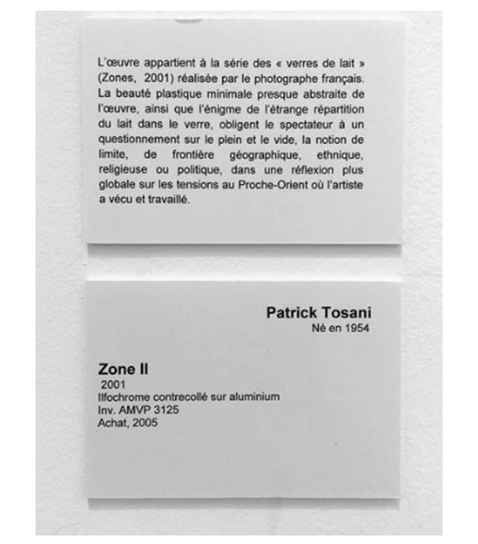
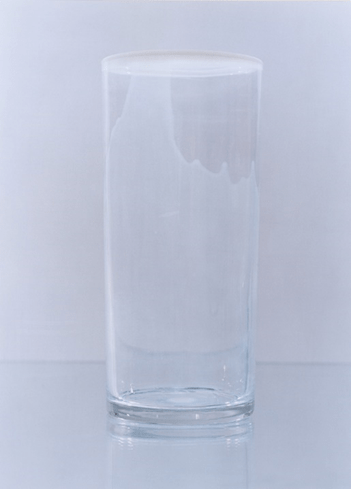
Sometimes, however, we must translate texts on works that do not resonate with us. Let’s look at how we would deal with an extreme case – a simple “glass of milk”, on display at the Palais de Tokyo in Paris:

Here, we may well look at the glass of milk and struggle to connect with it on an emotional level, but duty calls – we must find a way to make our translation as accessible as possible for the museum-goer. The rest is up to them.

I would translate this label as follows:

“This work is part of the French photographer’s “glasses of milk” series (Zones, 2001). The minimalist, almost abstract, plastic beauty of the piece, along with the mysterious positioning of the milk in the glass, forces the viewer to question the notions of negative and positive space, boundaries, and geographical, ethnic, religious and political divides, beckoning a broader reflection on the conflicts facing the Middle-East, where the artist lived and worked.”

Sometimes as translators we must remember that we are not the writer or the artist, and that our role is to simply keep things as clear as possible and faithful to the original, while using language to our advantage to spark an intellectual or emotional response in the viewer.

Telling a story: leaning into the literary

Museum writers are storytellers, and by extension translators must also adopt this role. It is my view that vivid images, sensorial language and clear structure allow for the most engaging explanatory texts in a museum context. Whenever I am sent museum labels or wall texts to translate, I see it as a great opportunity to think creatively and find the right words to capture the viewer’s imagination whilst remaining faithful to the original text.

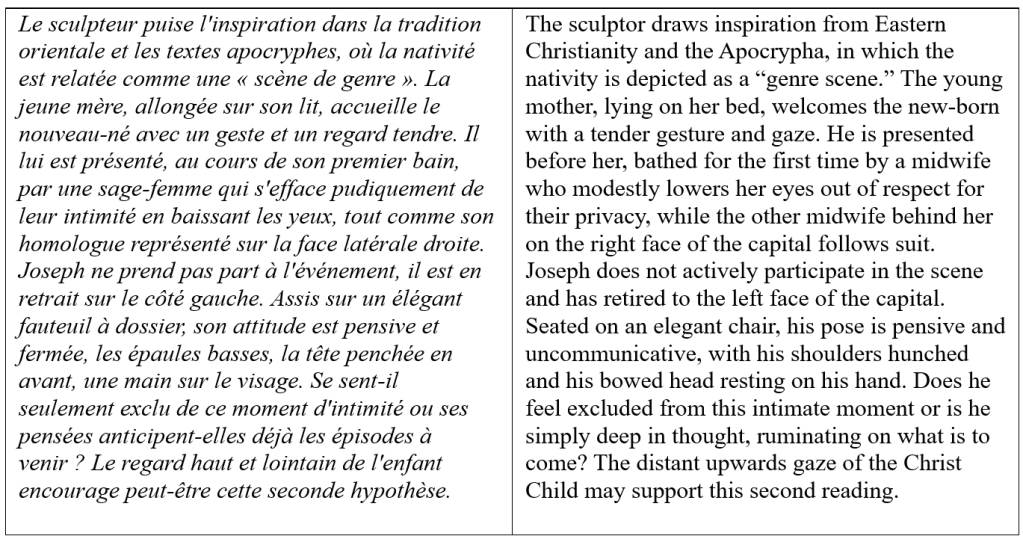
Take this example from my translation of the brochure offered to visitors of Autun Cathedral, which provides explanations of the cathedral’s famous column capitals. As many include complex religious symbols and details barely visible to the naked eye, I aimed for as clear a translation as possible to reflect the source while engaging the listener:

“Nativity” column capital at Autun Cathedral

The risks of cutting corners and the AI revolution

Art is the very visual representation of the human experience. It therefore seems logical that those who write about it should be human… Right?

In the current financial climate, cultural projects such as exhibitions run on a tight budget, with little left over to pay for professional translation services. The solution seems simple – to use AI for all exhibition text translations and save a buck or two.

The main issue with this is that AI does not yet understand nuance when it comes to linking a piece of art to its greater emotional and historical context, particularly when this extends beyond a mere recounting of Wikipedia facts. Concepts such as brushstrokes, shade, and iconography are delicate and require specialised knowledge. When dealing with French to English translations, a failure to recognise that “vide” does not always mean “empty”, “plastique” does not always mean plastic, and “attitude” does not always mean “attitude” can result in clunky, disastrous translations that leave the viewer feeling confused, distancing them from the artwork. These subtleties often go unnoticed by a non-native speaker, but once that text is on the wall, the museum’s very credibility is at risk.

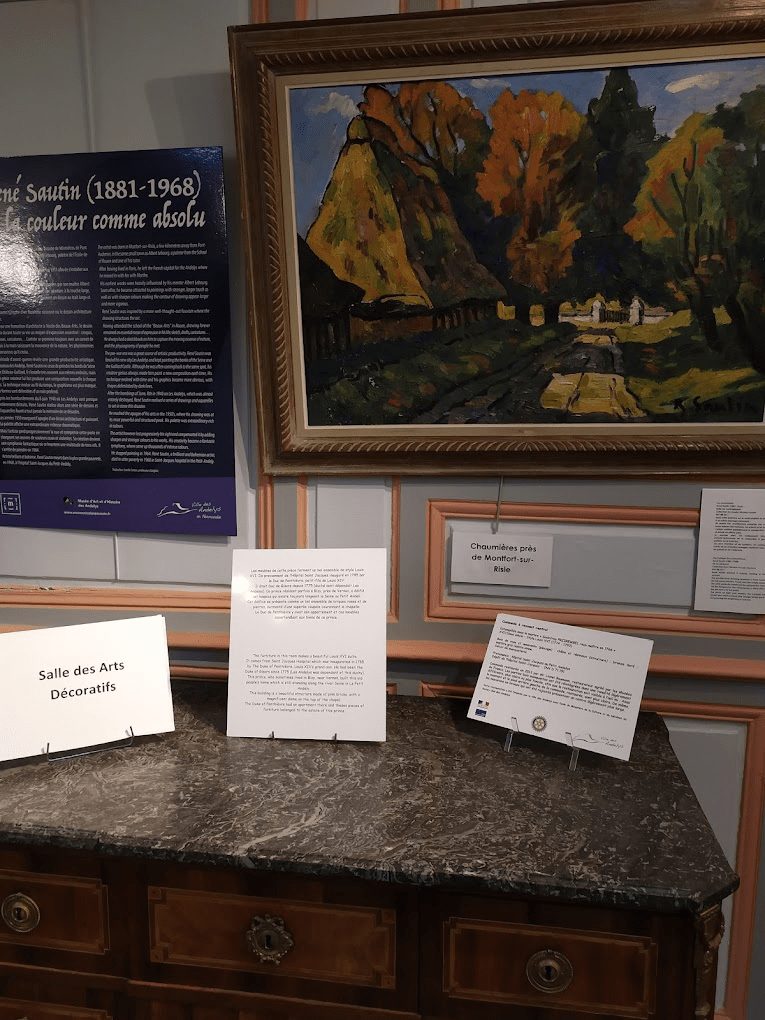
Some nice human translations in their natural environment: one of my past translations projects on display at the Musée Nicolas Poussin

For art’s sake…

Take it from a totally unbiased bystander: the best thing an art museum can do when trying to retain and attract non-native speakers is to call on the experience of a translator specialising in history of art. Over the years, I have worked on a wide range of translations from both French and Spanish into English specially tailored for a museum context. Drawing on my love of art, my knowledge of art history, and my language skills, providing translations of this type always fills me with joy and a great sense of purpose.


Are you a translator working in the field of museum and art translation or just an art lover? Add me on LinkedIn so we can share our experiences and exhibition recommendations!

Are you a company or individual looking for creative translation services from French or Spanish into English? Contact me for a quote or get in touch to find out more about the freelance translation services I offer.

Some notes on poetry translation

Poetry translation is one of the industry’s greatest linguistic challenges. For a translator, it represents a real opportunity to put our writing chops to the test and create, arguably, another piece of poetry altogether, bonded to the source text while standing alone in its own right.

Best way to attack a poetry translation? Printed out texts strewn across the table, a good set of coloured pencils, a strong coffee and a biscuit (or five)

Over the last few years, I’ve had the chance to work on a few projects that have involved the translation of poetry, all the way from full narrative poems to subtitling French drill. Here’s a look back at some of these projects, and the challenges and processes involved in their translation.

Une châtelaine envahissante

In the summer of 2021, I was asked by a Scottish translation agency to complete a test translation for a French poet who had been doing the rounds of different agencies, looking for the right translator to take on his 38-page narrative poem. After being selected by the author, I worked on the text for around a month, in close dialogue with the poet. The client brief was challenging to say the least – he wished to conserve both meaning and rhyme as much as possible. His main inspirations were Baudelaire and Lord Byron, and he wanted the translator to take inspiration from the French translation of Shakespeare’s sonnets – no pressure!

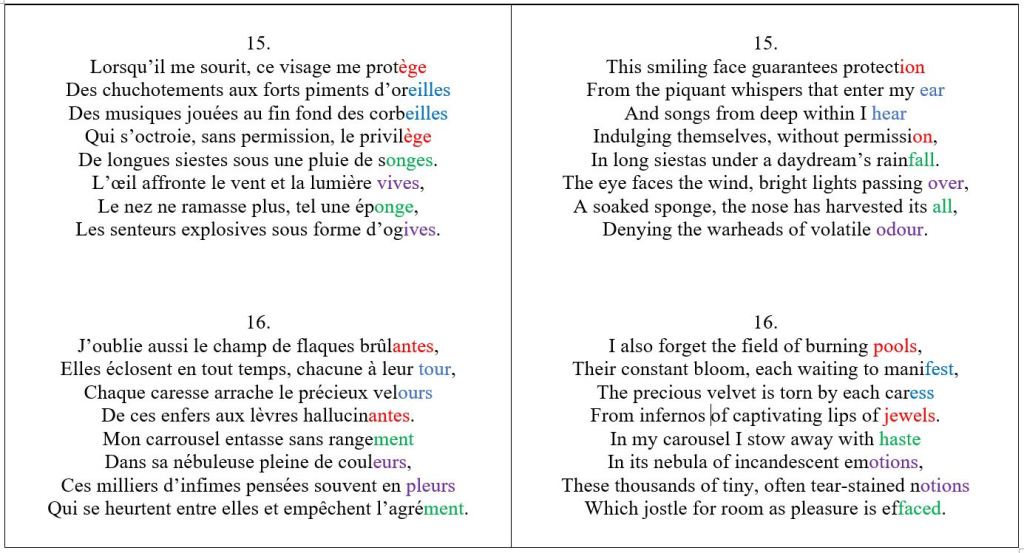
This excerpt demonstrates the rhyme pattern found in these poems. Replicating rhyme in translation often inherently involves a slight change in meaning, or at least a change in structure, which can be seen above. As the rhymes were mostly found at the end of each line, this acted as a constraint that would often need to be counterbalanced by the rest of the line. In an attempt to preserve meaning as much as possible, I used the rhyming word as a starting point, and worked the rest of the line to create a mirror image that would not stray too far from the source, while still conjuring up an effective image in English.

This poem takes the reader on a journey through a series of highly sensory metaphors, creating a sort of feverish dreamscape in which we plunge into the poet’s innermost emotional states. While trying to keep track of the general plot that guides the impressionistic verses, I treated each verse as a visual, sensory moment in itself, as a kind of word painting. Sometimes, near rhymes were the only available option in the semantic field associated with each line, but these nonetheless offered a certain musical symmetry, such as “manifest” and “caress”.

Creative licence was admittedly taken quite frequently, all under the watchful eye of the client, with whom I would discuss these decisions whenever necessary. The translation of “lèvres hallucinantes” as “lips of jewels” was an example of this. I needed to confer with the poet to find the exact image he wanted to convey, as “hallucinatory” was simply not an option (far too clunky and sterile). In the end, the important meaning to retain was this sense of marvel, in keeping with the near-delirium and enchantment provoked by feminine beauty in the poem.

The client was ultimately very pleased with the result and was touched to see his work translated into English. Looking back on this project, it would have been beneficial to talk one on one with the client via Zoom, rather than by e-mail. This, however, is the disadvantage of working with an individual client on a personal project through an agency. I hope to secure more private clients in the future for projects of this type.

Lisez-vous le belge ?

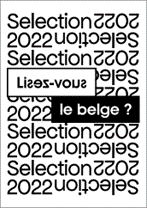
This project, as mentioned in my previous post, was one of my highlights of 2022. A campaign ran by Wallonie-Bruxelles International, its aim is to promote French-language literature from Belgium around the world. The project was a brochure comprised of a series of extracts of works by a selection of authors from the world of poetry, bande dessinée, fiction, non-fiction, YA and children’s literature. Here is one example from the brochure:

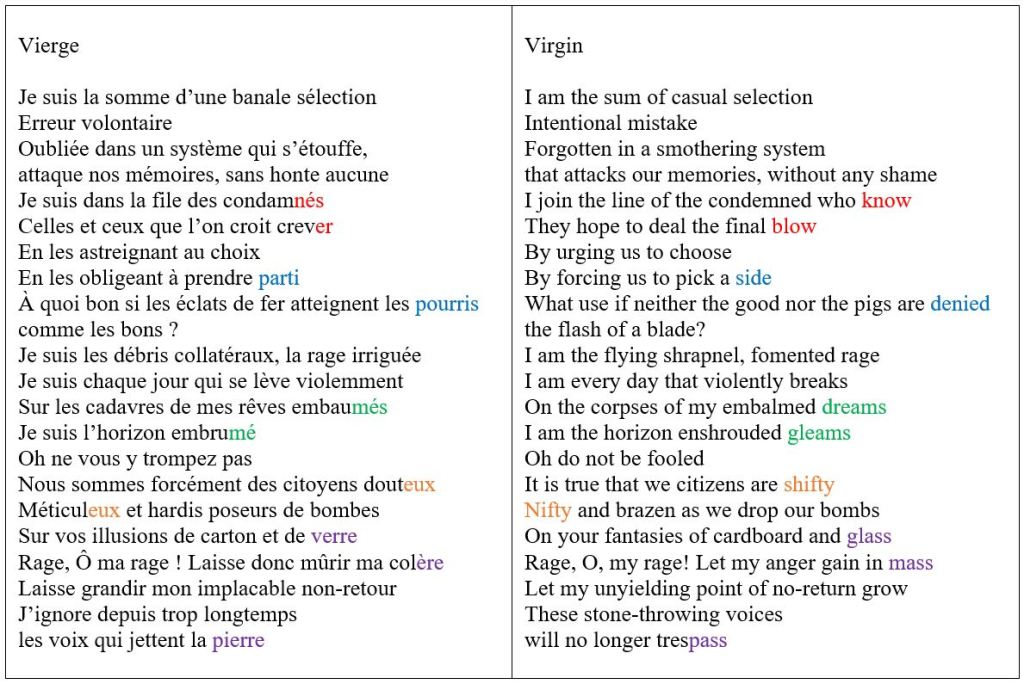
Virgin by Joëlle Sambi

The brochure opens with a high-impact slam poem by Belgian-Congolese poet and author Joëlle Sambi. Her work takes inspiration from the likes of Toni Morrison and Audre Lorde, and deals with themes of queerness, race, institutional violence and their intersectionalities. Below is my translation of one of her poems taken from her poetry collection Caillasses (Gravel), which received a literary award from the SCAM.

This poem was an interesting one to translate as it is extremely hard to transmit the pure emotion and raw power of slam poetry whilst approaching the text as an outsider. I would love to see alternative translations of the poem to compare and contrast, as the text could be handled in a number of ways. The three levels of separation during this project between me and the author made it hard to treat the project in the same way as I would treat a published translation, limiting the potential for dialogue that you find in long-term projects, but I nevertheless wanted to maintain a strong message and similar meter.

One of the greatest challenges here was how to translate the line: “À quoi bon si les éclats de fer atteignent les pourris / comme les bons?” After discussing the poem with a French speaking friend, we came to the conclusion that “éclats de fer” insinuated the presence of a weapon, and that “pourris” was likely to be a reference to the police. It was essential to preserve the meaning in this line, whilst not jumping the gun and ending up with a target text that assumes more than it translates. My solution to this was to shift the sentence structure so that I could get a nice rhyme between “side” and “denied” and find a nice natural split for the enjambement, while leaving the reader with a strong visual impact (“the flash of a blade”).

Here, I prioritised flow, message and rhyme placement. This meant that unfortunately some imagery had to be altered to the same effect. For example, I would have liked to include the image of “laisse donc murir ma colère” (“let my anger ripen”) but finding a good rhyme for the rather unforgiving words “cardboard and “glass” with a synonym for “ripe” or “ripen” proved to be very difficult. My solution was to keep an image of something growing, just like a ripening tomato swells and changes colour, hence the phrase “let my anger gain in mass”.

Personally, I loved this poem as well as the other slam poem included in the brochure, and look forward to reading more of Sambi’s work or maybe seeing her perform live if she stops by Lyon one day.

What poetry translation means to me

I have always found poetry translation from French into English to be extremely rewarding. I consider myself to be more of a “musical” than a “textbook” language learner, initially relying on the musicality and sound of a language to get to grips with it rather than pouring over grammar tables. These types of poetry translation services, along with editorial or even marketing translation, have a certain quality that engages the same part of my brain that helped me the most during my learning of French, Spanish, and now Greek! Starting the day by marking out rhyme patterns and meter and getting the old-school paper dictionary out; sitting in a pub and analysing my translations with a native speaker or fellow translator; a poet telling me that they found my translation moving and that it captured the poem’s essence… Those are the moments when I feel really lucky to be doing this as a career.

Having a wee browse through the poetry section of Barcelona’s La Central

Life as a freelance translator in Lyon

My move to France has been a long time coming. After finishing my studies, starting my career in Spain, and the Covid pandemic, there seemed to be no time like the present to take the leap and rediscover the culture that sparked my whole interest in languages and translation in the first place. Lyon was a perfect choice – it was big enough to offer plenty of culture and work opportunities, but small enough not to feel overwhelming. Two of my friends from my master’s were already based in the city, also working in the translation industry. Seeing their sunny apéro photos by the Saone, it was hard to resist the temptation of warmer climes.

First steps as a “micro-entrepreneur”

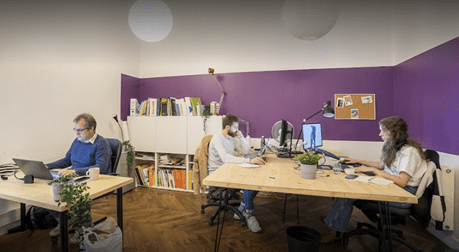
In late May of 2022, I packed a bag of summer clothes, my postcard collection, four books, and took the flight, self-employed visa in hand. Arriving in Lyon in the summer was a great introduction and allowed me to get to know the different neighbourhoods before the chaos of la rentrée. One of the first things I did after arriving was to join a coworking space I’d found out about online – l’Atelier des Médias – an association collectively run by people working in media. After almost four years of working from home and based on the experiences of other freelancers working in shared offices, I knew it would be the right decision.

As somewhat of an extrovert for a translator, I find that working in a shared space and bouncing ideas off others greatly improves and enriches my work. So, without hesitation, I took a fixed desk at l’ADM. Now, five months later, the coworking space has proved to be an immense source of productivity and fun and has really given a much-needed boost to my French speaking skills. Also, seeing the same friendly faces every day in the office or at lunch is a nice routine and it makes the city feel that little more like home.

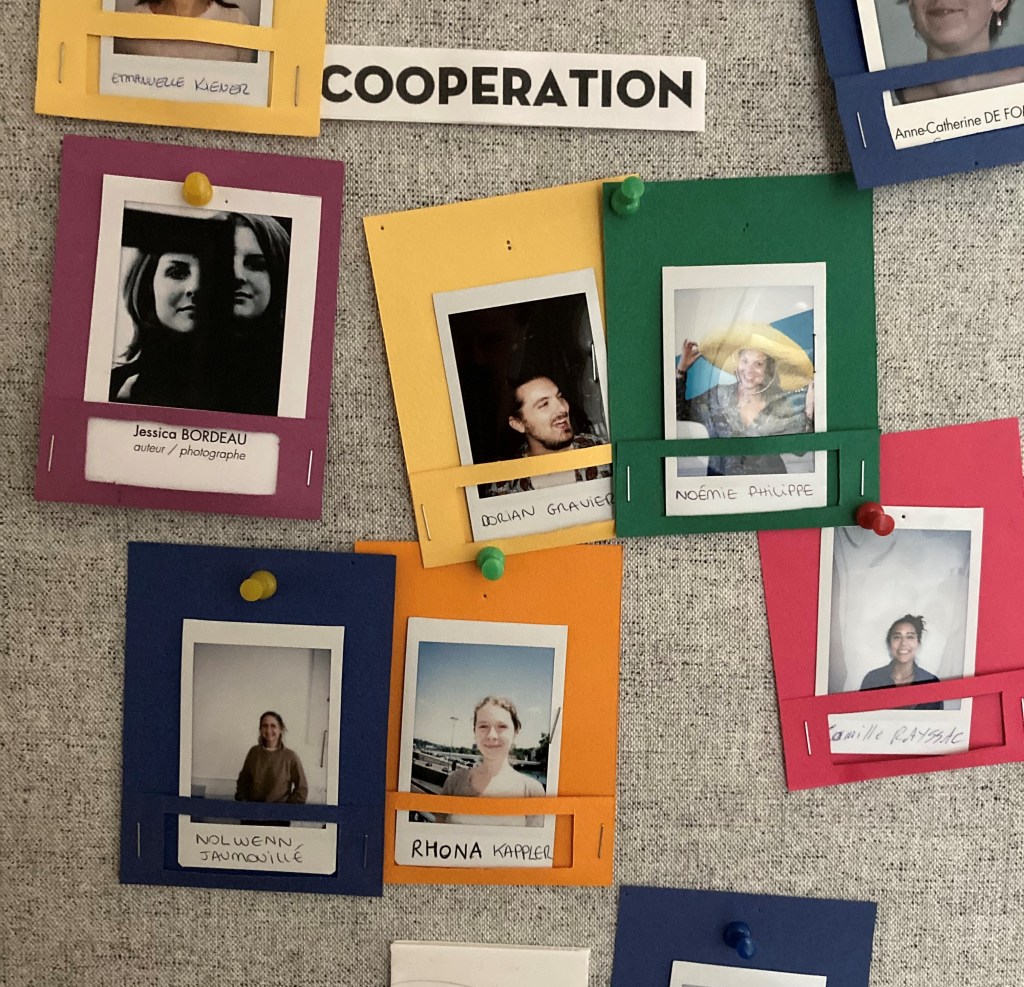
Me and the rest of the Co’op team at l’ADM

New city, new projects, forty-degree heat

In terms of projects, this year had got off to a promising start with my translation of the brochure Lisez-vous le belge? – a national campaign to promote Belgian literature. It was a challenging and rewarding project that really pushed me to adapt to different writing styles, setting the tone for my intention for the rest of the year. My aim in moving to France was not only to improve my language skills and cultural awareness but also to connect with new clients in the literary, artistic, tourism and heritage fields.

As I started to find my feet in this new market, exciting new projects naturally started coming in, and the new office space helped me to give them the time and attention they deserved. Handling this workload during the heatwave was challenging, with long hours and no air conditioning, but the dips in the Rhône outdoor swimming pool and cool Sunday evening picnics on Île Barbe made it all worth it.

Nothing says summer in Lyon like eating melon
off a magazine in the park

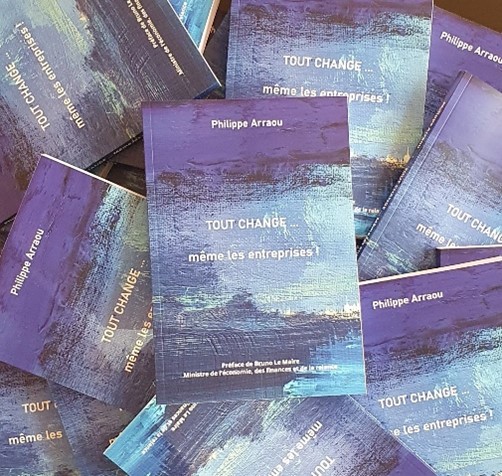
A large part of my summer was spent on a non-fiction translation project, to write the English version of Everything Changes – Even Businesses, the new book by Philippe Arraou, President of the French Association of Chartered Accountants. The book deals primarily with the subject of the digital transformation and changing work models and was an interesting challenge, requiring me to apply my love of creative prose to a more technical subject.

C’est la rentrée!

After the summer holidays, I experienced the famous rentrée rush. New projects came flooding in, including many new creative, literary and editorial opportunities. Translating Del Perrier’s new children’s book, Danse, mon amour, was a real joy and brought back fond memories of working on samples of illustrated novels for the SEA.

Autumn came around, the mosquitos stopped biting, and the cheesemongers started telling me apologetically that it was no longer “feta season” and that “raclette time” was upon us. I began to work more regularly on editorial projects in French and Spanish, thanks to a partnership with a young agency based in Valencia. As a child, I remember my obsession with Vogue and those full-page, conceptual fashion shoots I would cut out and blu-tack to my wall. Now, I actually had the chance to work with this agency on projects for the likes of Vogue, World of Interiors, and GQ! After a long wait, I was finally able to get my hands on the edited, physical version of my work for one of the magazines, immediately stopping to pour over the pages at a little café terrace near Place Saint-Jean. Seeing your work in print is a rare treat for any translator, credited or not, and this moment was a real source of motivation for me, reaffirming my sense of purpose in this new city.

Interpreting in a new context

These last five months have also been an opportunity for me to do my first interpreting jobs in France! Having worked previously as an interpreter in Spain and the UK, fulfilling the same role in a new country was a daunting but exciting prospect. I was invited to work in tandem with seasoned interpreter and fellow coworker Chloé Delhom for a conference held by plastic packaging manufacturer Texen. It was a full day of simultaneous interpreting, with a wide variety of both technical and corporate vocabulary to master. We managed to rise to the occasion and received positive feedback from the English-speaking guests, who were grateful for our presence during the event, which was held entirely in French.

More recently, I provided liaison interpreting services for MSI Services, a production line maintenance company, for an important meeting with their client Rheon, a Japanese manufacturer of food processing machinery. This project and the Texen conference were a much-appreciated chance for me to finally apply my training in a French context and enjoy the fast-paced, more socially oriented environment these projects provide. I’m keeping my fingers crossed for more opportunities like this in the months to come!

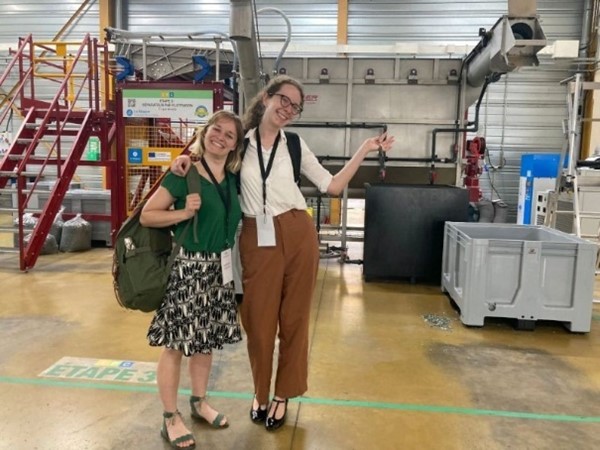
Me and Chloé at the Texen recycling plant

So, what’s next?

Ultimately, my ambition for the next few years is to be able to translate more published works and produce wall text translations for leading museums in France. Translating texts on themes such as art, nature, and music has an expressive quality that I find incredibly satisfying. I also hope to channel this creativity into more interpreting projects, as this is just as rich a way of helping people to cross cultural borders.

Things are looking promising in Lyon, and it is a real breath of fresh air compared to Edinburgh’s much smaller translation scene. Over the coming months, my goals are to expand my client base, discover more of the city’s art scene, continue bouldering and hiking with friends in my spare time, travel around France and, who knows, maybe stop eating so many pains au chocolat?