The hidden poetry of museum translations

From a young age, I’ve always preferred working behind the scenes to centre stage. I left school with a strong ambition to work in costume and set design for film and theatre, but after finding my path in languages and history of art, I realised that there were so many ways to recreate that backstage excitement. Museum translation definitely scratches that itch, and it has come to be one of my favourite disciplines as a creative professional translator. In this article, I take a look at some of the secrets and pitfalls that can make or break a multi-lingual exhibition, with a particular focus on French to English translations.

Keeping the voice evocative but accessible

Nobody can deny the beauty of the French language. Those who truly master it can push it to its elegant, playful and more abstract limits. This linguistic prowess can make for some beautiful texts, particularly in a museum context, but sometimes as translators we find the need to latch on to something more tangible in order to find the right flow in our translation. English does tend to be punchier and more direct, but this does not mean that any elegance or poetry needs to be lost in the final text.

The main challenge when translating exhibition labels, wall text or brochures from French into English is to grasp the meaning, maintain the style, and transform it into something equally evocative for an English reader. But there is one caveat – exhibition texts are displayed side by side, leaving any translation “exposed”. Delve too voraciously into transcreation, and you may fall prey to the critical eye of any bilingual visitors. Stay too close to the text, however, and you risk producing a rather waffly translation that readers can’t identify with. Museum visitors seek emotional engagement and will rarely have the patience to unravel tangled prose in order to seek meaning. A convoluted text can also be quite alienating for the visitor, leaving them feeling not “smart enough” and with a sense of imposter syndrome.

My solution? Making sure I fully understand what the source is trying to convey and formulating my translation after carefully examining the artwork in question. By forming my own emotional response as a viewer-translator, I can provide a natural sounding translation that is more likely to engage the museum visitor.

Sometimes, however, we must translate texts on works that do not resonate with us. Let’s look at how we would deal with an extreme case – a simple “glass of milk”, on display at the Palais de Tokyo in Paris:
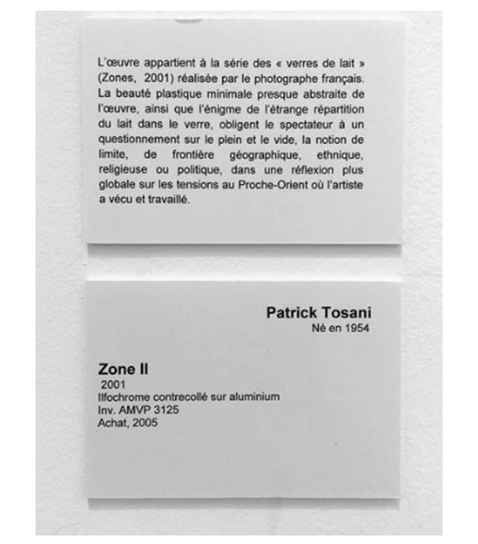
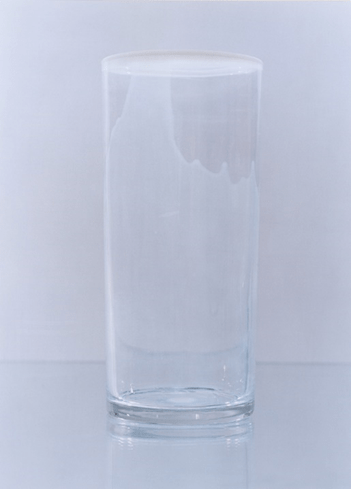
Here, we may well look at the glass of milk and struggle to connect with it on an emotional level, but duty calls – we must find a way to make our translation as accessible as possible for the museum-goer. The rest is up to them.

I would translate this label as follows:

“This work is part of the French photographer’s “glasses of milk” series (Zones, 2001). The minimalist, almost abstract, plastic beauty of the piece, along with the mysterious positioning of the milk in the glass, forces the viewer to question the notions of negative and positive space, boundaries, and geographical, ethnic, religious and political divides, beckoning a broader reflection on the conflicts facing the Middle-East, where the artist lived and worked.”

Sometimes as translators we must remember that we are not the writer or the artist, and that our role is to simply keep things as clear as possible and faithful to the original, while using language to our advantage to spark an intellectual or emotional response in the viewer.

Telling a story: leaning into the literary

Museum writers are storytellers, and by extension translators must also adopt this role. It is my view that vivid images, sensorial language and clear structure allow for the most engaging explanatory texts in a museum context. Whenever I am sent museum labels or wall texts to translate, I see it as a great opportunity to think creatively and find the right words to capture the viewer’s imagination whilst remaining faithful to the original text.

Take this example from my translation of the brochure offered to visitors of Autun Cathedral, which provides explanations of the cathedral’s famous column capitals. As many include complex religious symbols and details barely visible to the naked eye, I aimed for as clear a translation as possible to reflect the source while engaging the listener:

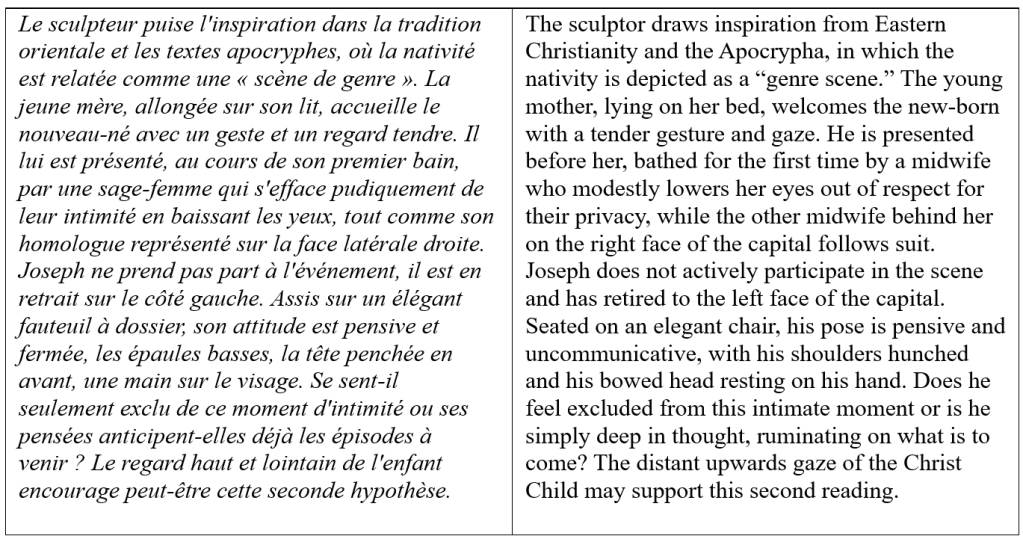
“Nativity” column capital at Autun Cathedral

The risks of cutting corners and the AI revolution

Art is the very visual representation of the human experience. It therefore seems logical that those who write about it should be human… Right?

In the current financial climate, cultural projects such as exhibitions run on a tight budget, with little left over to pay for professional translation services. The solution seems simple – to use AI for all exhibition text translations and save a buck or two.

The main issue with this is that AI does not yet understand nuance when it comes to linking a piece of art to its greater emotional and historical context, particularly when this extends beyond a mere recounting of Wikipedia facts. Concepts such as brushstrokes, shade, and iconography are delicate and require specialised knowledge. When dealing with French to English translations, a failure to recognise that “vide” does not always mean “empty”, “plastique” does not always mean plastic, and “attitude” does not always mean “attitude” can result in clunky, disastrous translations that leave the viewer feeling confused, distancing them from the artwork. These subtleties often go unnoticed by a non-native speaker, but once that text is on the wall, the museum’s very credibility is at risk.
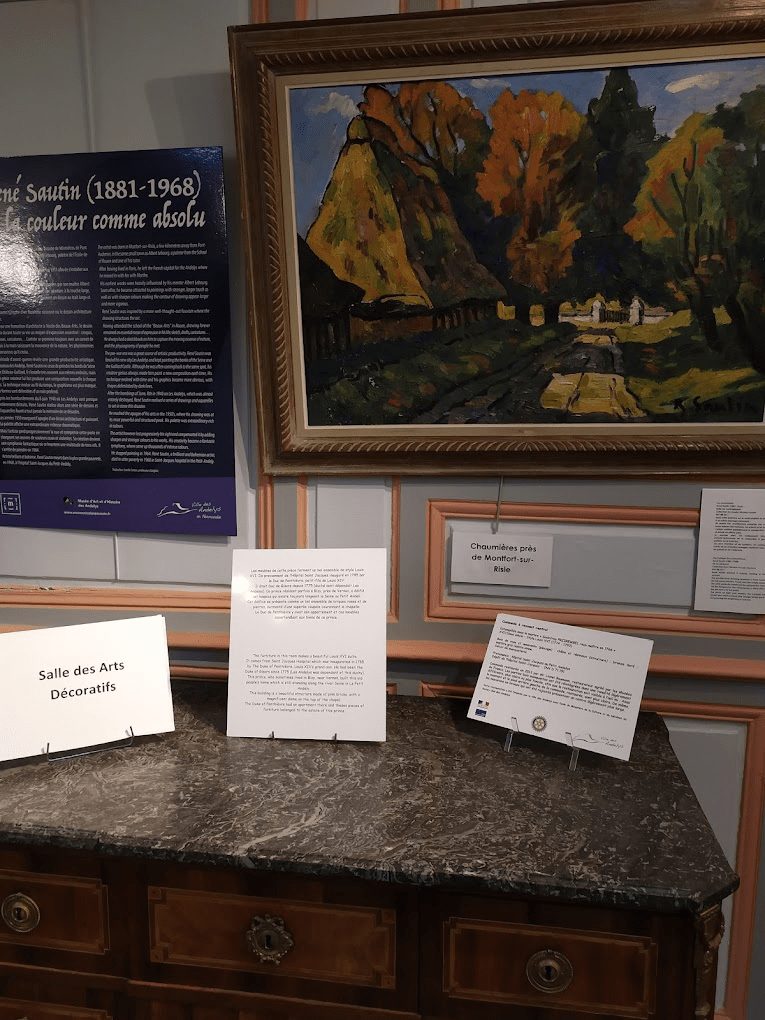
Some nice human translations in their natural environment: one of my past translations projects on display at the Musée Nicolas Poussin

For art’s sake…

Take it from a totally unbiased bystander: the best thing an art museum can do when trying to retain and attract non-native speakers is to call on the experience of a translator specialising in history of art. Over the years, I have worked on a wide range of translations from both French and Spanish into English specially tailored for a museum context. Drawing on my love of art, my knowledge of art history, and my language skills, providing translations of this type always fills me with joy and a great sense of purpose.


Are you a translator working in the field of museum and art translation or just an art lover? Add me on LinkedIn so we can share our experiences and exhibition recommendations!

Are you a company or individual looking for creative translation services from French or Spanish into English? Contact me for a quote or get in touch to find out more about the freelance translation services I offer.

Some notes on poetry translation

Poetry translation is one of the industry’s greatest linguistic challenges. For a translator, it represents a real opportunity to put our writing chops to the test and create, arguably, another piece of poetry altogether, bonded to the source text while standing alone in its own right.

Best way to attack a poetry translation? Printed out texts strewn across the table, a good set of coloured pencils, a strong coffee and a biscuit (or five)

Over the last few years, I’ve had the chance to work on a few projects that have involved the translation of poetry, all the way from full narrative poems to subtitling French drill. Here’s a look back at some of these projects, and the challenges and processes involved in their translation.

Une châtelaine envahissante

In the summer of 2021, I was asked by a Scottish translation agency to complete a test translation for a French poet who had been doing the rounds of different agencies, looking for the right translator to take on his 38-page narrative poem. After being selected by the author, I worked on the text for around a month, in close dialogue with the poet. The client brief was challenging to say the least – he wished to conserve both meaning and rhyme as much as possible. His main inspirations were Baudelaire and Lord Byron, and he wanted the translator to take inspiration from the French translation of Shakespeare’s sonnets – no pressure!

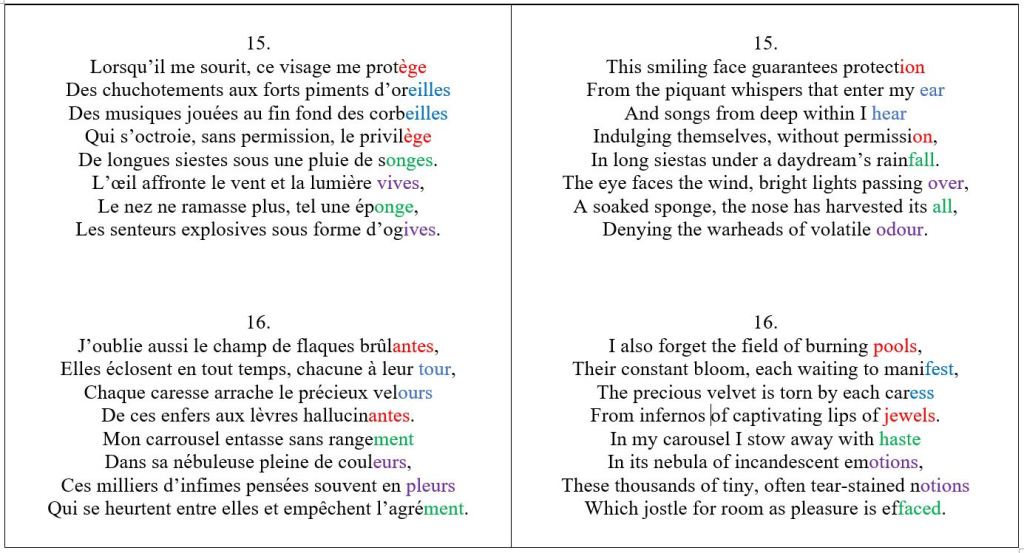
This excerpt demonstrates the rhyme pattern found in these poems. Replicating rhyme in translation often inherently involves a slight change in meaning, or at least a change in structure, which can be seen above. As the rhymes were mostly found at the end of each line, this acted as a constraint that would often need to be counterbalanced by the rest of the line. In an attempt to preserve meaning as much as possible, I used the rhyming word as a starting point, and worked the rest of the line to create a mirror image that would not stray too far from the source, while still conjuring up an effective image in English.

This poem takes the reader on a journey through a series of highly sensory metaphors, creating a sort of feverish dreamscape in which we plunge into the poet’s innermost emotional states. While trying to keep track of the general plot that guides the impressionistic verses, I treated each verse as a visual, sensory moment in itself, as a kind of word painting. Sometimes, near rhymes were the only available option in the semantic field associated with each line, but these nonetheless offered a certain musical symmetry, such as “manifest” and “caress”.

Creative licence was admittedly taken quite frequently, all under the watchful eye of the client, with whom I would discuss these decisions whenever necessary. The translation of “lèvres hallucinantes” as “lips of jewels” was an example of this. I needed to confer with the poet to find the exact image he wanted to convey, as “hallucinatory” was simply not an option (far too clunky and sterile). In the end, the important meaning to retain was this sense of marvel, in keeping with the near-delirium and enchantment provoked by feminine beauty in the poem.

The client was ultimately very pleased with the result and was touched to see his work translated into English. Looking back on this project, it would have been beneficial to talk one on one with the client via Zoom, rather than by e-mail. This, however, is the disadvantage of working with an individual client on a personal project through an agency. I hope to secure more private clients in the future for projects of this type.

Lisez-vous le belge ?

This project, as mentioned in my previous post, was one of my highlights of 2022. A campaign ran by Wallonie-Bruxelles International, its aim is to promote French-language literature from Belgium around the world. The project was a brochure comprised of a series of extracts of works by a selection of authors from the world of poetry, bande dessinée, fiction, non-fiction, YA and children’s literature. Here is one example from the brochure:

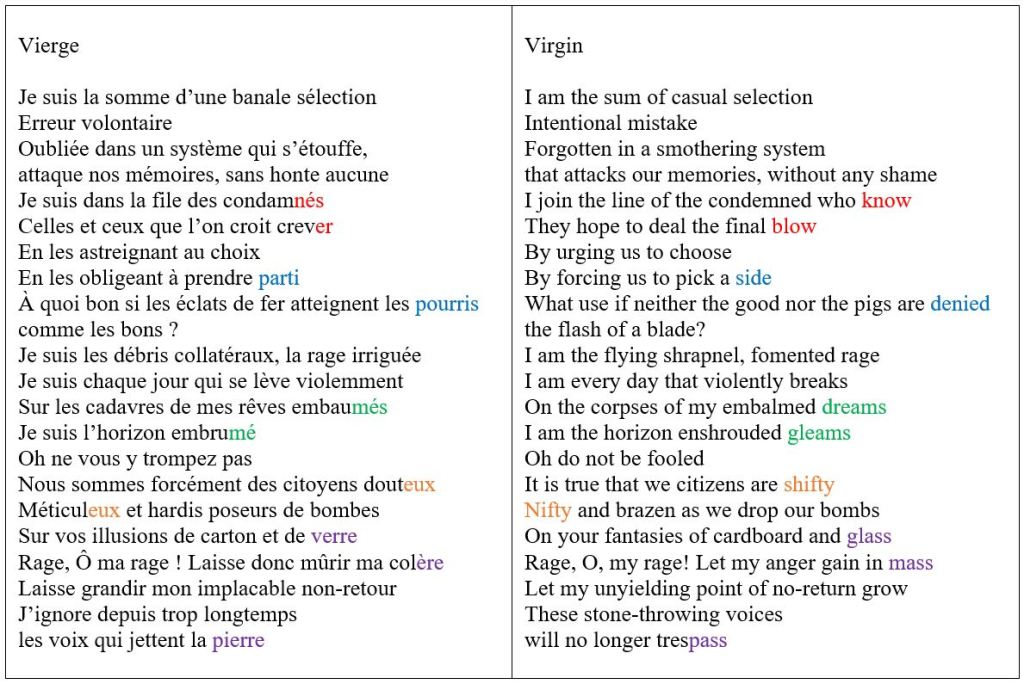
Virgin by Joëlle Sambi

The brochure opens with a high-impact slam poem by Belgian-Congolese poet and author Joëlle Sambi. Her work takes inspiration from the likes of Toni Morrison and Audre Lorde, and deals with themes of queerness, race, institutional violence and their intersectionalities. Below is my translation of one of her poems taken from her poetry collection Caillasses (Gravel), which received a literary award from the SCAM.

This poem was an interesting one to translate as it is extremely hard to transmit the pure emotion and raw power of slam poetry whilst approaching the text as an outsider. I would love to see alternative translations of the poem to compare and contrast, as the text could be handled in a number of ways. The three levels of separation during this project between me and the author made it hard to treat the project in the same way as I would treat a published translation, limiting the potential for dialogue that you find in long-term projects, but I nevertheless wanted to maintain a strong message and similar meter.

One of the greatest challenges here was how to translate the line: “À quoi bon si les éclats de fer atteignent les pourris / comme les bons?” After discussing the poem with a French speaking friend, we came to the conclusion that “éclats de fer” insinuated the presence of a weapon, and that “pourris” was likely to be a reference to the police. It was essential to preserve the meaning in this line, whilst not jumping the gun and ending up with a target text that assumes more than it translates. My solution to this was to shift the sentence structure so that I could get a nice rhyme between “side” and “denied” and find a nice natural split for the enjambement, while leaving the reader with a strong visual impact (“the flash of a blade”).

Here, I prioritised flow, message and rhyme placement. This meant that unfortunately some imagery had to be altered to the same effect. For example, I would have liked to include the image of “laisse donc murir ma colère” (“let my anger ripen”) but finding a good rhyme for the rather unforgiving words “cardboard and “glass” with a synonym for “ripe” or “ripen” proved to be very difficult. My solution was to keep an image of something growing, just like a ripening tomato swells and changes colour, hence the phrase “let my anger gain in mass”.

Personally, I loved this poem as well as the other slam poem included in the brochure, and look forward to reading more of Sambi’s work or maybe seeing her perform live if she stops by Lyon one day.

What poetry translation means to me

I have always found poetry translation from French into English to be extremely rewarding. I consider myself to be more of a “musical” than a “textbook” language learner, initially relying on the musicality and sound of a language to get to grips with it rather than pouring over grammar tables. These types of poetry translation services, along with editorial or even marketing translation, have a certain quality that engages the same part of my brain that helped me the most during my learning of French, Spanish, and now Greek! Starting the day by marking out rhyme patterns and meter and getting the old-school paper dictionary out; sitting in a pub and analysing my translations with a native speaker or fellow translator; a poet telling me that they found my translation moving and that it captured the poem’s essence… Those are the moments when I feel really lucky to be doing this as a career.

Having a wee browse through the poetry section of Barcelona’s La Central